
Factors & multiples
Common multiples, GCF, LCM, primes, & the FTA
Questioning is the foundation of all learning.
The first step in rejecting not knowing is to ask, why?
Sweetland
Introduction
Overview
- Introduction
- Facts, Concepts, and Generalizations
- Multiples introduction & worksheets
- Common multiples & least common multiple (LCM) introduction & worksheets
- Factors
- Worksheets
- Complete set of factors to 50 with frequency - Data table
- Primes
- Factor trees
- Using primes to find GCF & LCM
- Application question for LCM
- Application question for GCF
- A prime study of whole numbers to 30 and the Fundamental theory of arithmetic (FTA)
- Fundamental Theory of Arithmetic chart with primes
This page explores properties of whole numbers: multiples, factors, primes, least common multiple (LCM), greatest common factor (GCF) and the fundamental theory of arithmetic (FTA). It includes an instructional sequences, focus questions and problems along with suggestions, procedures, and worksheets for introducing and exploring these concepts.
Activity sequence
- Introduce multiples and how to generate them.
- Common multiples and least common multiple (LCM)
- Factors
- Greatest common factor (GCF)
- Primes
- Using primes to find LCM & GCF
- Fundamental theory of arithmetic (FTA)
Facts, Concepts, and Generalizations related to multiples, factors and primes
Number value and operations
Multiples
- Multiples can be generated by skip counting. However, ... see related concepts.
- Multiples are products of unitized groups (a number of groups and units in the group).
- Multiplicative (2n) is different than additive (n+n). Skip counting is additive (0) (2) (2 + 2) (2 + 2 + 2).
Example
3 + 2 is a group of 3 plus a group of 2 or 5.
(⚽⚽⚽ ) + (⚽⚽) =
(⚽⚽⚽⚽⚽)
3 * 2 is three groups of two or 6.
(⚽⚽)+(⚽⚽)+ (⚽⚽) =
(⚽⚽)
(⚽⚽)
(⚽⚽) - Multiple is a number that results from multiplying a given number by an integer (multiples of 0, 12 are 12, 24, 36, 48...).
- When learners count groups and then announce the product you can conclude they are unitizing and using a multiplicative strategy.
- Properties of multiples.
- Infinite: Every number has an endless sequence of multiples (they go on forever).
- Divisibility: A number is a multiple of another if it can be divided by that number with no remainder.
- Zero is a multiple: Zero is a multiple of every number (5 * 0 = 0).
- Self-multiple: Every number is a multiple of itself ((7 * 1 = 7).
- Common Multiple: A number that is a multiple of two or more different numbers. For example, 12 is a common multiple of both 3 and 4.
- Least Common Multiple (LCM): The smallest shared multiple between two or more numbers. For example, the common multiples of 4 and 6 include 12, 24, and 36, making 12 the least common multiple
Factors
- Factor is a number that divides evenly into another number (e.g., factors of 12 are 1, 2, 3, 4, 6, 12). Factors are finite.
- Factors are numbers that are multiplied together and result in a product. a * b = c; a and b are factors and c is the product.
- Multiply a number by another number and the result will have as many factors as the product (multiplicative relationship) of the factors (4 has 3 factors (1, 2, 4); 3 has 2 factors (1, 3); 12 has 6 factors (1, 2, 3, 4, 6, 12); 3 factors * 2 factors = 6 factors).
Positive integers
Every positive integer is composite, prime, or the unit 1, so the composite numbers are exactly the natural numbers that are not prime and not a unit.
Prime numbers
- A prime number has only two factors - itself and one. One is not a prime, it has only one factor.
- Every number has a unique (one and only one) prime factorization (Fundamental Theorem of Arithmetic).
- Primes only have two factors so if you multiply it by another prime, that makes three factors (2*1) [2 primes] (3*1) [2 primes or one more - since 1 is in both].
- When multiplying primes the exponent is one less than the number of factors ( 32 ) is 9 which has three factors. (1, 3, 9)
Composite numbers
- Composite numbers are positive integers greater than 1 that can be made by multiplying two smaller positive integers.
- Composite numbers can be arranged into rectangles but prime numbers cannot..
- A positive integer that has at least one divisor other than 1 and itself.
Data analysis
- Ordering by value can help discover relationships.
- Putting data in a chart can help distinguish relationships.
- Ordering by equality can help distinguish relationships.
- Venn diagrams can show relationships.
Reasoning and proof
- Finding a counter example will disprove a conjecture.
- Disproving a conjecture can provide insight.
- When explaining (justify) my ideas it is important to select and include accurate information that is necessary and sufficient.
- It's helpful to see and hear other peoples' ideas to get different views and insights.
- Systematically exploring all possibilities can be used as a proof.
Multiples
Background
Multiples can be generated by skip counting. However, multiples are multiplicative (2n) while skip counting is additive (n+n); (0) (2) (2 + 2) (2 + 2 + 2). More on multiplication representations.
Multiples are products of unitized groups (a number of groups and units in the group).
3 * 2 is three groups of two where Each group is the unit.
(⚽⚽)+(⚽⚽)+ (⚽⚽) =
(⚽⚽)
(⚽⚽)
(⚽⚽)
Multiple is a number that results from multiplying a given number by an integer (e.g., multiples of 0, 12 are 12, 24, 36, 48...).
When learners count groups and then announce the product you can conclude they are unitizing and using a multiplicative strategy.
Properties of multiples.
- Infinite: Every number has an endless sequence of multiples (they go on forever).
- Divisibility: A number is a multiple of another if it can be divided by that number with no remainder.
- Zero is a multiple: Zero is a multiple of every number (5 * 0 = 0).
- Self-multiple: Every number is a multiple of itself ((7 * 1 = 7).
Finding multiples
To find multiples of numbers you can suggest to start with the number, write it down, then think of another group of that number and write the number for the two groups. Then continue for 3, 4, 5, ... groups of the number.
See - Blank Find the multiples worksheet
Find the multiples
Directions: Find the multiples for these numbers.
Multiples of two.
(2, 4, 6, 8, 10, 12, 14, 16, 18, 20 ...)
Multiples of three.
(3, 6, 9, 12, 15, 18 ...)
Multiples of four.
(4, 8, 12, 16, 20, ...)
Multiples of five.
(5, 10, 15, 20, ...)
While it's good to remember that zero is a multiple of all numbers, it would be problematic when you are looking for least common multiples, as it would always be zero.
However, saying the LCM of 4 and 6 is zero instead of 12 provides no useful information for real-world tasks using a least common multiple. Therefore, we define the LCM to exclude zero by defining the LCM as the smallest positive common multiple.
While this can be assumed in elementary mathematics, some advanced mathematics use zero as a multiple.
Multiples with Cuisenaire trains
Use the following representation of Cuisenaire rods above a number line and explain how they represent multiples of two, three, four, five, and six.
(Each rod represents a multiplicative representation)
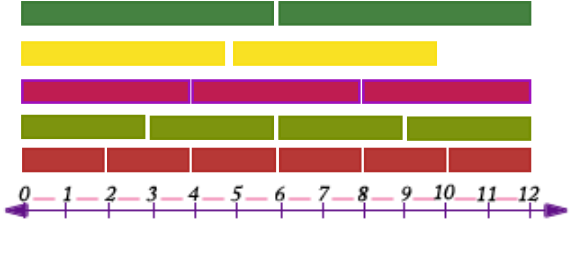
What would a representation using squares and rectangles look like. (use graph paper to represent it).

Common multiples
A common multiple is a positive whole number that is a multiple of two or more numbers.
For example, 12 is a common multiple of both 3 and 4.
Since multiples and common multiples are infinite, lets limit them to less than 31 as we explore common multiples for some numbers.
To find common multiples we first find the multiples of the numbers.
For three and four less than 31:
Multiples of three.
(3, 6, 9, 12, 15, 18, 21, 24, 27, 30)
Multiples of four.
(4, 8, 12, 16, 20, 24, 28)
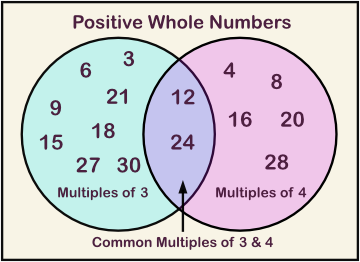
We can see the numbers in both sets of multiples, that are the same are 12 and 24. ∴ the common multiples of 3 & 4 < 31 are 12 & 24.
We can illustrate this with a Venn diagram.
Summary
Least Common Multiple (LCM): The smallest shared multiple between two or more numbers.
For example,
The common multiples of three and four are 12, 24, 36, ...
With the least common multiple 12.
Find the common multiple for the set of numbers on this worksheet! and identify the LCM.
Find the multiples
Directions: Find the multiples for these numbers.
Multiples of two.
(2,
Multiples of three.
(3,
Multiples of four.
(4,
Multiples of five.
(5,
Multiples of
(
Find the common multiples
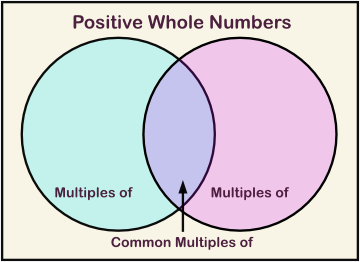
Directions: Select numbers, find the common multiples less than ____, complete a Venn diagram, and write the LCM.
Multiple bank starters ...
(2, 4, 6, 8, 10, 12, 14, 16, 18, 20
(3, 6, 9, 12, 15, 18
(4, 8, 12, 16, 20,
(5, 10, 15, 20,
What is the least common multiple (LCM)
What is the least common multiple (LCM)
Factors
Instructional suggestions and sequence
Background
- Factor is a number that divides evenly into another number (e.g., factors of 12 are 1, 2, 3, 4, 6, 12). Factors are finite.
- Factors are numbers that are multiplied together and result in a product. a * b = c; a and b are factors and c is the product.
- Multiply a number by another number and the result will have as many factors as the product (multiplicative relationship) of the factors (4 has 3 factors (1, 2, 4); 3 has 2 factors (1, 3); 12 has 6 factors (1, 2, 3, 4, 6, 12); 3 factors * 2 factors = 6 factors).
Finding factors
Pose a question about the number of factors a particular number or set of numbers have and invite learners to discover them.
Ask. How did you know or find them?
Use their answer to explore finding factors.
Possibly using responses to lead to examples like below.
Example for factors of six
Ask. How can we find the factors of six? accept all answers and record a procedure to generalize for finding factors.
Possible example:
Start by making an open set of parentheses as you ask the question.
( )
What is the first and last factor? It is always one and the number.
So put them in the parentheses.
(1, 6)
Go to the next positive whole number - two and ask if it is a factor of the number (6)?
If it is, put it and its factor in the set. write 2 , 3 in parentheses.
If not ask if the next positive whole number is and so on till you meet a factor you have in the parentheses.
(1, 2, 3, 6)
Say. OH! look 2 and 6. We met in the middle so we have all the factors.
Let's check. Is four a factor of six? no
Is five? no
Then we have found all the factors of six.
For fun, let's try a larger number.
Example for factors of 36
Ask. How can we find the factors of thirty-six? build on previous example to generalize a procedure for finding factors.
Example:
Making an open set of parentheses as you ask the question.
( )
Put the first and last factor in the parentheses.
(1, 36)
Ask. What do we do next? We go to the next positive whole number - two and ask if it is a factor of the number (36)?
If it is, put it and its factor in the set. write 2 , 18 in parentheses.
(1, 2, 18, 36)
Ask. What do we do next? Go to the next positive whole number -3 and ask if it is a factor of 36?
It is, so write it and its factor in the parentheses.
(1, 2, 3, 12, 18, 36)
Ask. What do we do next? Go to the next positive whole number - 4 and ask if it is a factor of 36? Yes 4 *9 is 36 and
(1, 2, 3, 4, 9, 12, 18, 36)
Ask. What do we do next? Go to the next positive whole number -6 and ask if it is a factor of 36?
It is, so write it and its factor in the parentheses.
(1, 2, 3, 4, 6 9, 12, 18, 36)
OH! look 6 and 6. We met in the middle so we have all the factors.
Wow! 36 has a nice set of factors.
Factors as multiplicative
Have them make representations of different numbers and their factors to demonstrate the multiplicative aspect of factors. Factor representation worksheet
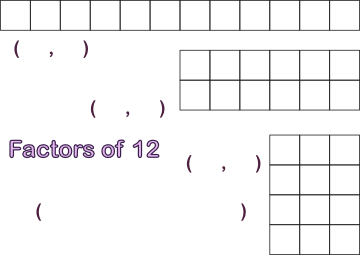
Create a procedure to factor any number
After the learners become familiar with finding factors ask them if we can write a procedure together for factoring numbers.
Factorization heuristic:
- Make open parentheses with plenty of space between the open and closing parenthesis.
- Enter the smaller factor, one next to the left parenthesis or opening parenthesis
- Enter the larger factor next to the right parenthesis or closing parenthesis.
- You now have the smallest and largest factors.
- Ask if two is a factor. (Hint all even numbers have two as a factor.) If it is, write a comma next to one, and enter two (smaller factor of the next factor pair).
- Find the larger factor that when multiplied by two equals the number you are factoring.
- Write it to the left of the number being factored, next to the closing parenthesis and follow it with a comma.
- Check to see if three, is a possible factor,
- If it is, then add it to the right of two followed by a comma.
- Write its factor pair left of the last factor entered on the right side and place a comma after it.
- Continue increasing by one checking for the next factor and writing them in the list as you find them.
- When the value of the factors meets, you have found them all.
Congratulations!
That is a lot of words and not what most of us want to take class time writing it all out. How about a brief summary.
Summary
To find all the factors of a number make a comma separated list from one to the number being factored. Trying all whole numbers one at a time until you meet.
To help with finding factors check out Memorizing basic facts & algorithms section on - Development of multiplication and division facts for ideas on how to recognize multiples and factors.
Moving on to mastery of factorization
Review what we know and make a list or table of factors to explore factors and use as a bridge to discover relationships.
Note:
When learners discover numbers with the same factors, mention common factors. And when they discover ones with no factors, but one and itself, then mention primes. This will open the door to relationships of factors for different products and common factors for different numbers.
Also remember to continue to reinforce opportunities to understand multiplicative relationships for factors instead of an additive relationship. This will set the stage to develop the greatest common factor (GCF) and prime factorization.
Review and encourage more study with the following questions.
Focus questions & problems to explore
- What is a factor?
Factor is a number that divides evenly into another number (e.g., factors of 12 are 1, 2, 3, 4, 6, 12). Factors are finite.
Factors are numbers that are multiplied together and result in a product. a * b = c; a and b are factors and c is the product. - How many factors does a number have?
Depends on the number. the least would be two if it is a prime, one and itself. And I suspect the number of factors could be infinite since numbers are infinite. - How many factors for the number one?
Two? ... 2
Three? ... 2
Four? ... 3 - two is only used once. Because When we write out a list of unique factors, we cannot write the same number twice. Writing a list like 1, 2, 2, 4 doesn't make sense because 2 is just one unique number. Therefore factors with two identical numbers, squares (2*2 or 2 2), will have an odd number of factors.
Suggest they explore factors of numbers to 50 in their groups using the factors to 50 worksheet.
After completing review these questions.
- What number from 1-50 has the most factors?
- What number from 1-50 has the least number of factors?
- Is there a relationship for the number of factors between numbers?
- Can we figure any out?
- What happens when the numbers are doubled?
- What if we sort numbers (1-50) by the number of factors for each number? Factor sort 1-50 worksheet
- How can we use the relationships we found to find more factors? or Fill in the table?
Hopefully you will have some who what to continue their exploration with questions like:
- What number from 1-100 has the most factors?
- What number from 1-100 has the least number of factors?
To explore and begin to answer these questions we can use the following:
Worksheets:
- Factors for numbers 1 - 50 table - blank table to add factors
- Factors for numbers 1 - 50 - sorted by least to most
- Factors for numbers 1 - 100 table
- Factors for numbers 1-100 - sorted by least to most
- A prime study of whole numbers (FTA)
- Discussion of multiples, primes, & the fundamental theory of arithmetic (FTA)
As learners explore and find the factors for the numbers 1-50 or 1-100 they will be developing fluency. After which they will be ready to explore common factors, greatest common factor, primes, prime factorization, and the fundamental theory of arithmetic (FTA).
Common factors & greatest common factor (GCF)
The greatest common factor (GCF) is a common factor of two or more sets of factors that is the largest. The factor that is in all sets that is the largest.
Example
Factors of six:
(1, 2, 3, 6)
Factors of 36:
(1, 2, 3, 4, 6 9, 12, 18, 36)
Common factors:
(1, 2, 3, 6)
The largest factor in both sets is six.
6 is the GCF of 6 & 36.
Twelve is a factor of thirty-six. Why can't it be the GCF?
Primes
Background
- A prime number has only two factors - itself and one. One is not a prime, it has only one factor.
- Every number has a unique (one and only one) prime factorization (Fundamental Theorem of Arithmetic).
- Primes only have two factors so if you multiply it by another prime, that makes three factors and it isn't a prime. (2*1) [2 primes] (3*1) [2 primes or one more - since 1 is in both].
- When multiplying primes the exponent is one less than the number of factors ( 32 ) is 9 which has three factors. (1, 3, 9)
Finding primes
Pose a question about a particular number or set of numbers as being primes and invite learners to discover some.
Ask. How did you know or find them?
Use their answer to explore finding primes.
Possibly work their responses to lead to using factor trees for prime factorization.
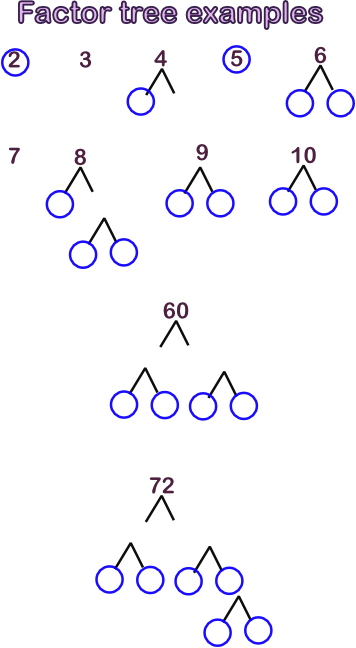
Factor tree example
To use factor trees to find a prime factorization.
- Write the number.
- Is it a prime?
- If it is circle it and you are done.
- If it isn't, draw two lines below for its factors.
- Write the factors at the end point of each line.
- Continue the process until only primes are left.
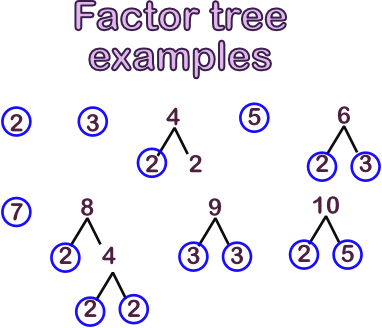
Let's try one a bit more fun!
Like 60.
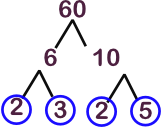
The factors of 60 are (1, 2, 3, 4, 5, 6, 10, 12, 15, 20, 30, 60) Wow! that's a lot!
If we pair them up and find the prime factors for each factor.
We see that the four primes are all used in each, only in different orders.
1, 60 - (1) (60 - 2, 2, 3, 5)
2, 30 - (2) (30 - 2, 3, 5)
3, 20 - (3) (20 - 2, 2, 5)
4, 15 - (4 - 2, 2) (15 - 3, 5)
5, 12 - (5) (12 - 2, 2, 3)
6, 10 - (6v- 2, 3) (10 - 2, 5)
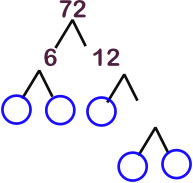
Use a tree to find the primes for 72!
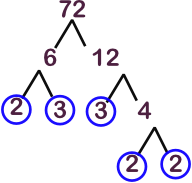
Using primes to find the GCF & LCM

Application question for LCM
Imagine you run an automated manufacturing plant.
It's important to keep things running safely and to keep the machine working without shutting down the whole factory at once.
The different machines require safety inspections at different regular intervals:
- Conveyor Belts must be inspected every 12 days.
- Robotic Arms must be inspected every 18 days.
- Packaging Stations must be inspected every 30 days.
All three systems were inspected today (Day 0) the day you started operations.
You suspect that there might be a future day where all machines might need inspection on the same day.
Is that true, and if so, how many days will pass before they all need to be inspected on the exact same day?
You need to know, because if all three systems are down for maintannce and inspection at the same time, it will require shutting down all operations and hiring extra temporary technicians.
How can you use multiple to answer your questions?
Hint:
Before you jump to finding multiples for the three numbers, slow down, think, and consider finding their primes with factorization trees and using the information to find the LCM.
If represented with a timeline and three line jumpers, what would it look like and how would primes be represented on the same line?
Application question for GCF
Imagine you own a store.
You have some extra inventory that you need to sell.
You decide to bundle them, create identical bundles.
You look in your warehouse and find you have:
- 48 Kit Kat bars
- 72 Reese's Peanut butter cups
- 120 Mini Hersey bars
Your decide to make the largest possible number of identical bundles to clean up all of this inventory.
You want every bundle to have the same mix of items so that you don't have any items left over (because leftover inventory sits on shelves and wastes money).
What will the bundles be?
Hint:
Solving using prime factorization. Quicker than guess and check numbers or using trial-and-error to see how to divide 48, 72, and 120.
- 24 X 3
- 23 X 32
- 23 X 3 X 5
How are primes used for web security?
Every time you enter a password, buy something Online, or check your bank account, your device relies on prime factorization to keep your data safe from hackers.
Investigate how this is done.
Proof using the Fundamental Theory of Arithmetic
After learners understand factors, common factors and primes they should get to know about the fundamental theory of arithmetic (FTA).
Opportunities might occur to introduce it after exploring factors of the first 50 or 100 whole integers. Or after introducing primes and revisiting factors of the first 50 or 100 whole integers to explore the primes and composites and find patterns.
The following is a discussion of a learner's question that was restated as a conjecture that lead to the fundamental theory of arithmetic (FTA) to validate it as a proof.
The set up!
While exploring multiples and common multiples a group says:
Look!
You can figure out the next (second) common multiple by doubling the least common multiple (LCM).
Then added, "Does it always work?"
After prompted to try to find a counter example. They replied...
So far I cannot find a non example of this conjecture.
Turning it back to me.
Do you know of any two numbers where this conjecture does not work???
Let's review what you have so far:
Conjecture: The second common multiple is always a double of the least common multiple (LCM).
Specific examples generated by the group:
Take two numbers. Say 3 and 4.
Find the first common multiple by listing all the multiples for each:
- Common multiples of three: 0, 3, 6, 9, 12, 15, 18, 21, 24, 27, 30, 33, 36, ...
- Common multiples of four: 0, 4, 8, 12, 16, 20, 24, 28, 32, 36, ...
Therefore, the first common multiple (LCM) is 12, the second is 24, the third is 36, ...
Therefore, for this example the first common multiple (LCM) is 12 and the second is 24; and 24 is twice 12.
Hence, the question ...
Will the second common multiple of all other numbers like here (24 in this example) always be twice the first?
Teacher decision time:
- Should I stay with generating multiples for different numbers, compare them, and let the group see how all the examples are multiples of two and hope the ah ha moment ... that all second multiples are two times the first, therefore, double.
O - Use prime factorizations to show how the second multiple has the same factors as the first multiple and two. Therefore, as a multiple of two, a double.
An added bonus with the second method is: it can provide an excellent opportunity to introduce the Fundamental Theorem of Mathematics (FTA) as a stronger proof and to provide a wider application for the understanding of multiples, factors,LCM, GCF, and their relationships.
I proceed:
What are the primes for the sets of multiples (3 and 4)?
Maybe if we look at prime factors for each multiple, we may be able to see a pattern to generalize for multiples.
So a list of the prime factors for the first few multiples of three and four.
To 12, the LCM.
0
3 - 3
6 - 2, 3
9 - 3, 3
12 - 2, 2, 3
0
4 - 2, 2
8 - 2, 2, 2
12 - 2, 2, 3 ---> notice....
We can see that 12 has the same prime factors.
Let's continue to 24 and see what it looks like.
0
3 - 3
6 - 2, 3
9 - 3, 3
12 - 2, 2, 3
15 - 3, 5
18 - 2, 3, 3,
21 - 3, 7
24 - 2, 2, 2, 3 ---> notice
We can see that 24 has exactly the same as the prime factors of 12 (12 - 2, 2, 3) and an additional 2! Hence double.
Let's see what happens One more time ... to 36?
0
3 - 3
6 - 2, 3
9 - 3, 3
12 - 2, 2, 3 ---> notice
15 - 3, 5
18 - 2, 3, 3,
21 - 3, 7
24 - 2, 2, 2, 3 ---> notice
27 - 3, 3, 3
30 - 2, 3, 5
33 - 3, 11
36 - 2, 2, 3, 3 ---> notice this is exactly the same as the prime factors of 12 * 3 or triple.
0
4 - 2, 2
8 - 2, 2, 2
12 - 2, 2, 3 ---> notice....
16 - 2, 2, 2, 2
20 - 2, 2, 5
24 - 2, 2, 2, 3 ---> notice...
28 - 2, 2, 7
32 - 2, 2, 2, 2, 2
36 - 2, 2, 3, 3 ---> notice ...
Wow! they are the same as in twelve only now there is a three instead of a two.
Some might see a pattern and believe the conjecture true. And extend it to the second LCM is twice, and the third LCM is three times.
If they want you can continue to 48 and some might expect a factor of 4, not thinking it is a composite (not prime) and will be surprised when they see two twos.
Either way, I believe it is necessary to include another step, and illustrate this with the Fundamental Theorem of Arithmetic.
To get to that discovery, look at the prime factors for the first 25 whole numbers?
0 - not a prime by definition
1 - not a prime by definition
2 - 2
3 - 3
4 - 2, 2
5 - 5
6 - 2, 3
7 - 7
8 - 2, 2, 2
9 - 3, 3
10 - 2, 5
11 - 11
12 - 2, 2, 3
13 - 13
14 - 2, 7
15 - 3, 5
16 - 2, 2, 2, 2
17 - 17
18 - 2, 3, 3
19 - 19
20 - 2, 2, 5
21 - 3, 7
22 - 2, 11
23 - 23
24 - 2, 2, 2, 3
25 - 5, 5
Okay now, which of the numbers have exactly the same factors?
NONE?
WOW! Every whole number is a product of a unique set of prime numbers. In other words a group of primes has only one product. AND every whole number only has one set of prime numbers that can be used to make that number.
Now. If you are all still with me, put these two ideas together and think of
12 as the group of primes 2, 2, 3.
In order to get the next multiple, of that number, it would have to include another prime factor; and the smallest prime is 2.
Oh, wow!
- 12 = 2 * 2 * 3 and multiply it by the smallest prime
- 2 * 2 * 3 * 2
- and where was something like that seen before?
- 24 = 2 * 2 * 2 * 3
Summary
Let's represent primes to 30 on a number line:
Fundamental Theory of Arithmetic

Therefore, if every whole number can be expressed as a unique group of primes, then any whole number (which would include any LCM for any group of numbers) would have as its next multiple one more factor and the smallest factor that it could be is two.
SOoo, anyone that wants to find a counterexample that doesn't fit this groups conjecture, probably will have a long search.
YES! Wasn't that fun?
Factor worksheets
Factor representations
Complete the labels for the factors of 12 representation.
Make one of your own below.
Table for factors for 1 - 50
| Number | Factors | Number of Factors |
|---|---|---|
| 1 | 1*1 ---------> [1] | |
| 2 | 1*2 ---------> [1, 2] | |
| 3 | 1*3 ---------> [1, 3] | |
| 4 | 1*4, 2*2 ---------> [1, 2, 4] | |
| 5 | 1*5 ---------> [1, 5] | |
| 6 | ||
| 7 | ||
| 8 | ||
| 9 | ||
| 10 | ||
| 11 | ||
| 12 | ||
| 13 | ||
| 14 | ||
| 15 | ||
| 16 | ||
| 17 | ||
| 18 | ||
| 19 | ||
| 20 | ||
| 21 | ||
| 22 | ||
| 23 | ||
| 24 | ||
| 25 | ||
| 26 | ||
| 27 | ||
| 28 | ||
| 29 | ||
| 30 | ||
| 31 | ||
| 32 | ||
| 33 | ||
| 34 | ||
| 35 | ||
| 36 | ||
| 37 | ||
| 38 | ||
| 39 | ||
| 40 | ||
| 41 | ||
| 42 | ||
| 43 | ||
| 44 | ||
| 45 | ||
| 46 | ||
| 47 | ||
| 48 | ||
| 49 | ||
| 50 |
Table for factors for numbers 1 - 50 - so
Sorted by least to most
| One Factor *** |
Two Factors |
Three Factors √√√ |
Four Factors |
Five Factors ∆∆∆ |
Six Factors |
Seven Factors ΩΩΩ |
Eight Factors |
Nine Factors ∑∑∑ |
Ten Factors |
|---|---|---|---|---|---|---|---|---|---|
Factors for numbers 1 - 50 complete
Add 51-100
| Number | Factors | Number of Factors |
|---|---|---|
| 1 | 1*1 ---------> [1] | 1 *** |
| 2 | 1*2 ---------> [1, 2] | 2 |
| 3 | 1*3 ---------> [1, 3] | 2 |
| 4 | 1*4, 2*2 ---------> [1, 2, 4] | 3 √√√ |
| 5 | 1*5 ---------> [1, 5] | 2 |
| 6 | 1*6, 2*3 ---------> [1, 2, 3, 6] | 4 |
| 7 | 1*7 ---------> [1, 7] | 2 |
| 8 | 1*8, 2*4, ---------> [1, 2, 4, 8] | 4 |
| 9 | 1*9, 3*3 ---------> [1, 3, 9] | 3 √√√ |
| 10 | 1*10, 2*5 ---------> [1,2 5, 10] | 4 |
| 11 | 1*11 ---------> [1, 11] | 2 |
| 12 | 1*12, 2*6, 3*4 ---------> [1, 2, 3, 4, 6, 12] | 6 |
| 13 | 1*13 ---------> [1, 2] | 2 |
| 14 | 1*14, 2*7 ---------> [1, 2, 7, 14] | 4 |
| 15 | 1*15, 3*5 ---------> [1, 3, 5, 15] | 4 |
| 16 | 1*16, 2*8, 4*4 ---------> [1, 2, 4, 8, 16] | 5 ∆∆∆ |
| 17 | 1*17 ---------> [1, 17] | 2 |
| 18 | 1*18, 2*9, 3*6 ---------> [1, 2, 29, 18] | 4 |
| 19 | 1*19 ---------> [1*19] | 2 |
| 20 | 1*20, 2*10, 4*5 ---------> [1, 2, 4, 5, 10, 20] | 6 |
| 21 | 1*21 ---------> [1, 3, 7, 21] | 2 |
| 22 | 1*22, 2*11 ---------> [1, 2, 11, 11] | 4 |
| 23 | 1*23 ---------> [1, 23] | 2 |
| 24 | 1*24, 2*12, 3*8, 4*6 ---------> [1, 2, 3, 4, 6, 8, 12, 24] | 8 |
| 25 | 1*25, 5*5 ---------> [1, 5, 25] | 3 √√√ |
| 26 | 1*26, 2*13 ---------> [1, 2, 13, 26] | 4 |
| 27 | 1*27, 3*9 ---------> [1, 3, 9, 27] | 4 |
| 28 | 1*28, 2*14, 4*7 ---------> [1, 2, 4, 7, 14, 28] | 6 |
| 29 | 1*29 ---------> [1, 29] | 2 |
| 30 | 1*30, 2*15, 3*10, 5*6 ---------> [1, 2, 3, 5, 6, 10, 15, 30] | 7 ΩΩΩ |
| 31 | 1* 31 ---------> [1, 31] | 2 |
| 32 | 1*32, 2*16, 4*8 ---------> [1, 2, 3, 4, 8, 16, 32] | 7 ΩΩΩ |
| 33 | 1*33, 3*11 ---------> [1, 3, 11, 33] | 4 |
| 34 | 1* 34, 2*17 ---------> [1, 2, 17, 34] | 4 |
| 35 | 1*35, 5*7 ---------> [1, 5, 7, 35] | 4 |
| 36 | 1*36, 2*18, 3*12, 4*9, 6*6 ---------> [1, 2, 3, 4, 6, 9, 12, 18, 36] | 9 ∑∑∑ |
| 37 | 1*37 ---------> [1, 37] | 2 |
| 38 | 1*38, 219, ---------> [1, 2, 19, 38] | 4 |
| 39 | 1*39, 3*13 ---------> [1, 3, 13, 39] | 4 |
| 40 | 1*40, 2*20, 4*10, 5*8 ---------> [1, 2, 4, 5, 8, 10, 20, 40] | 8 |
| 41 | 1*41 ---------> [1, 41] | 2 |
| 42 | 1*42, 2* 21, 3*14, 6*7 ---------> [1, 2, 3, 6, 7, 14, 21, 42] | 8 |
| 43 | 1*43 ---------> [1, 43] | 2 |
| 44 | 1*44, 2*22, 4*11, ---------> [1, 2, 4, 11, 22, 44] | 6 |
| 45 | 1*45, 3*15, 5*9, ---------> [1, 3, 5, 9, 15, 45] | 6 |
| 46 | 1*46, 2*23 ---------> [1, 2, 23, 46] | 4 |
| 47 | 1*47 ---------> [1, 47] | 2 |
| 48 | 1*48, 2*24, 3*16, 4*12, 6*8 ---------> [1,2, 3, 4, 6, 8, 12, 16, 24, 48] | 10 |
| 49 | 1*49, 7*7 ---------> [1, 7, 49] | 3 √√√ |
| 50 | 1*50, 2*25, 5*10, ---------> [1, 2, 5, 10, 25, 50] | 6 |
| 51 | ||
| 52 | ||
| 53 | ||
| 54 | ||
| 55 | ||
| 56 | ||
| 57 | ||
| 58 | ||
| 59 | ||
| 60 | ||
| 61 | ||
| 62 | ||
| 63 | ||
| 64 | ||
| 65 | ||
| 66 | ||
| 67 | ||
| 68 | ||
| 69 | ||
| 70 | ||
| 71 | ||
| 72 | ||
| 73 | ||
| 74 | ||
| 75 | ||
| 76 | ||
| 77 | ||
| 78 | ||
| 79 | ||
| 80 | ||
| 81 | ||
| 82 | ||
| 83 | ||
| 84 | ||
| 85 | ||
| 86 | ||
| 87 | ||
| 88 | ||
| 89 | ||
| 90 | ||
| 91 | ||
| 92 | ||
| 93 | ||
| 94 | ||
| 95 | ||
| 96 | ||
| 97 | ||
| 98 | ||
| 99 | ||
| 100 |
Number of factors for numbers 1 - 50
Sorted by least to most
| 1 *** |
2 |
3 √√√ |
4 |
5 ∆∆∆ |
6 |
7 ΩΩΩ |
8 |
9 ∑∑∑ |
10 |
11 | 12 | 13 | 14 | 15 | 16 | 17 | 18 | 19 | 20 |
|---|---|---|---|---|---|---|---|---|---|---|---|---|---|---|---|---|---|---|---|
| 1 | 2 | 4 | 6 | 16 | 12 | 30 | 24 | 36 | 48 | ||||||||||
| 3 | 9 | 8 | 18 | 32 | 40 | ||||||||||||||
| 5 | 25 | 10 | 20 | 42 | |||||||||||||||
| 7 | 49 | 14 | 28 | ||||||||||||||||
| 11 | 15 | 44 | |||||||||||||||||
| 13 | 21 | 45 | |||||||||||||||||
| 17 | 22 | 50 | |||||||||||||||||
| 19 | 26 | ||||||||||||||||||
| 23 | 27 | ||||||||||||||||||
| 29 | 33 | ||||||||||||||||||
| 31 | 34 | ||||||||||||||||||
| 37 | 35 | ||||||||||||||||||
| 41 | 38 | ||||||||||||||||||
| 43 | 39 | ||||||||||||||||||
| 47 | 46 | ||||||||||||||||||
Factors for the first 50 numbers
| Number | Factors | Number of Factors |
|---|---|---|
| 1 | 1*1 ---------> [1] | 1 *** |
| 2 | 1*2 ---------> [1, 2] | 2 |
| 3 | 1*3 ---------> [1, 3] | 2 |
| 4 | 1*4, 2*2 ---------> [1, 2, 4] | 3 √√√ |
| 5 | 1*5 ---------> [1, 5] | 2 |
| 6 | 1*6, 2*3 ---------> [1, 2, 3, 6] | 4 |
| 7 | 1*7 ---------> [1, 7] | 2 |
| 8 | 1*8, 2*4, ---------> [1, 2, 4, 8] | 4 |
| 9 | 1*9, 3*3 ---------> [1, 3, 9] | 3 √√√ |
| 10 | 1*10, 2*5 ---------> [1,2 5, 10] | 4 |
| 11 | 1*11 ---------> [1, 11] | 2 |
| 12 | 1*12, 2*6, 3*4 ---------> [1, 2, 3, 4, 6, 12] | 6 |
| 13 | 1*13 ---------> [1, 2] | 2 |
| 14 | 1*14, 2*7 ---------> [1, 2, 7, 14] | 4 |
| 15 | 1*15, 3*5 ---------> [1, 3, 5, 15] | 4 |
| 16 | 1*16, 2*8, 4*4 ---------> [1, 2, 4, 8, 16] | 5 ∆∆∆ |
| 17 | 1*17 ---------> [1, 17] | 2 |
| 18 | 1*18, 2*9, 3*6 ---------> [1, 2, 29, 18] | 4 |
| 19 | 1*19 ---------> [1*19] | 2 |
| 20 | 1*20, 2*10, 4*5 ---------> [1, 2, 4, 5, 10, 20] | 6 |
| 21 | 1*21 ---------> [1, 21] | 2 |
| 22 | 1*22, 2*11 ---------> [1, 2, 11, 11] | 4 |
| 23 | 1*23 ---------> [1, 23] | 2 |
| 24 | 1*24, 2*12, 3*8, 4*6 ---------> [1, 2, 3, 4, 6, 8, 12, 24] | 8 |
| 25 | 1*25, 5*5 ---------> [1, 5, 25] | 3 √√√ |
| 26 | 1*26, 2*13 ---------> [1, 2, 13, 26] | 4 |
| 27 | 1*27, 3*9 ---------> [1, 3, 9, 27] | 4 |
| 28 | 1*28, 2*14, 4*7 ---------> [1, 2, 4, 7, 14, 28] | 6 |
| 29 | 1*29 ---------> [1, 29] | 2 |
| 30 | 1*30, 2*15, 3*10, 5*6 ---------> [1, 2, 3, 5, 6, 10, 15, 30] | 7 ΩΩΩ |
| 31 | 1* 31 ---------> [1, 31] | 2 |
| 32 | 1*32, 2*16, 4*8 ---------> [1, 2, 3, 4, 8, 16, 32] | 7 ΩΩΩ |
| 33 | 1*33, 3*11 ---------> [1, 3, 11, 33] | 4 |
| 34 | 1* 34, 2*17 ---------> [1, 2, 17, 34] | 4 |
| 35 | 1*35, 5*7 ---------> [1, 5, 7, 35] | 4 |
| 36 | 1*36, 2*18, 3*12, 4*9, 6*6 ---------> [1, 2, 3, 4, 6, 9, 12, 18, 36] | 9 ∑∑∑ |
| 37 | 1*37 ---------> [1, 37] | 2 |
| 38 | 1*38, 219, ---------> [1, 2, 19, 38] | 4 |
| 39 | 1*39, 3*13 ---------> [1, 3, 13, 39] | 4 |
| 40 | 1*40, 2*20, 4*10, 5*8 ---------> [1, 2, 4, 5, 8, 10, 20, 40] | 8 |
| 41 | 1*41 ---------> [1, 41] | 2 |
| 42 | 1*42, 2* 21, 3*14, 6*7 ---------> [1, 2, 3, 6, 7, 14, 21, 42] | 8 |
| 43 | 1*43 ---------> [1, 43] | 2 |
| 44 | 1*44, 2*22, 4*11, ---------> [1, 2, 4, 11, 22, 44] | 6 |
| 45 | 1*45, 3*15, 5*9, ---------> [1, 3, 5, 9, 15, 45] | 6 |
| 46 | 1*46, 2*23 ---------> [1, 2, 23, 46] | 4 |
| 47 | 1*47 ---------> [1, 47] | 2 |
| 48 | 1*48, 2*24, 3*16, 4*12, 6*8 ---------> [1,2, 3, 4, 6, 8, 12, 16, 24, 48] | 10 |
| 49 | 1*49, 7*7 ---------> [1, 7, 49] | 3 √√√ |
| 50 | 1*50, 2*25, 5*10, ---------> [1, 2, 5, 10, 25, 50] | 6 |
Prime factoring tree worksheet
Directions: Complete the trees.