
Professional Mathematics Educators
Information to Describe & Become Outstanding Professional Mathematics Educators
Questioning is the foundation of all learning.
The first step in rejecting not knowing is to ask, why?
Sweetland
Introduction
Overview
When a professional educator creates a personal professional educator conceptual framework for their knowledge base, it will include the knowledge areas for the students we will teach. This will vary depending on the subject areas for which we are preparing. Therefore, the goal for this article is to explore the subject of mathematics and how mathematical information can be included in a professional educator framework / knowledge base so we can use it effectively to teach and learn mathematics, as well as assess and reflect on the progress of our professional development.
To do this we will identify the essential components of mathematical literacy and how our conceptual framework informs our teaching, of mathematical information, of our students to promote mathematical dispositions they will use use to become mathematical literate and life long learners.
How to integrate mathematical knowledge & pedagogy into a professional math educator's knowledge base & conceptual framework
Two basic things are needed:
- A comprehensive process for professional mathematical development that ensures authentic planning and decision-making that integrates our existing knowledge with contemporary research and practical wisdom to validate or enhance our teaching decisions. Thereby positively impacting our learners’ mathematical literacy development. This process provides will provide professional educators with substantial resource to make numerous and intricate decisions to facilitate mathematical literacy.
- A detailed description of the mathematical knowledge, processes, and dispositions is essential for professional educators to possess, in order to effectively facilitate mathematical literacy. This encompasses both mathematical ideas in a mathematical knowledge base and pedagogical ideas important for a professional educator's mathematical conceptual framework / knowledge base to facilitate mathematical literacy.
What process?
A process to inquire and reflect on what outstanding teachers know and do to facilitate learning; and a reflective cycle that assesses where to begin and how to progress from our current understanding and practices related specifically to mathematics.
It is crucial to acknowledge and articulate our underlying beliefs, assumptions, and philosophies to support our instructional goals. By employing these ideas as the foundation for our reasoning, we can effectively select practices and assess their outcomes to enhance student learning of mathematics.
Furthermore, our model should emphasize the role of research and practical wisdom in guiding a decision-making processes. Through reflection on the disparities and similarities between various approaches, we can identify opportunities for beneficial change as we determine whether our current practices align with the mathematical needs of our students.
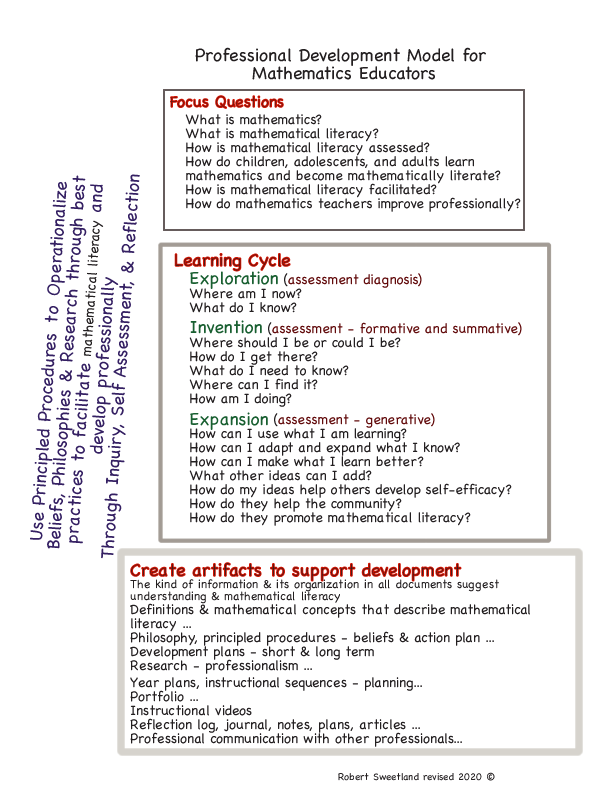
The model below serves as a process framework and learning cycle to explore focus questions to facilitate our professional development and helpour students as a mathematics educator.
What do professional educators need to know and be able to do?
What do professional educators need to know and be able to do?
These focus questions will help answer this:
- What is mathematics?
- What do people need to know to use mathematics and be mathematically literate?
- How do we assess what people know about mathematics - math literacy?
- How do children, adolescents, and adults learn mathematics - become math literate?
- How do we facilitate people's understanding of mathematical literacy?
- How do we improve our understanding of mathematics and how do we help others improve their understandings?
There are three kinds of knowledge to consider as professional mathematical educators to reflect and prepare for making decisions:
- General worldly knowledge;
- General pedagogical knowledge to consider for a professional educator conceptual framework for their knowledge base and
- Specific mathematical content knowledge and how it relates to itself, the world, and pedagogical knowledge.
Information from all three are important to consider as we inquire what to include in our professional mathematical framework.
While there are many details and systematic ways to organize mathematical concepts described in numerous scholarly publications, it is essential we find an organization that is useful for each of us.
Since it is known outstanding educators possess a substantial amount of mathematical knowledge stored in their memory to enable them to make prompt decisions that relate to the learners they are working with. Thus, if we fail to have a strong knowledge base, our decision-making abilities are diminished, and our students will be less likely to acquire proficiency in mathematics and in worse cases may develop math anxiety.
Likewise, outstanding mathematics educators construct a comprehensive understanding of pedagogical knowledge to effectively know how to utilize their knowledge to facilitate mathematical literacy. Which can be guided with our principled procedures for mathematics educators and curriculum decision makers.
The quantity and quality of information an individual possesses in both areas directly correlates with the range and quality of choices available for their decision-making. This, in turn, influences the likelihood of success for our learners and ourselves as educators.
A quick summary of mathematical research to support the importance of knowing mathematical and pedagogical knowledge is summarize and condensed in these three landmark articles.
Supporting Research for change

Reprinted with permission: |
|---|
Kappan. Beyond the Math Wars: the importance of knowledgeable mathematics teachers.pdf. By Rachel S. McClam, Rebecca A. Cruz. Dec 2, 2024. |
Kappan. The Politics of California School Mathematics: The Anti-Reform of 1997-99.pdf by Jerry P. Becker and Bill Jacob, Vol. 81, No. 7 (Mar., 2000), pp. 529-532, 534-537 |
Kappan, The Mathematical Miseducation of America's Youth: Ignoring Research and Scientific Study in Education.pdf. by Michael T. Battista, February 1999. |
Consider the focus questions to create your comprehensive mathematical conceptual framework.
What is Mathematics? - definitions
Define Mathematics and Mathematical Literacy
Review definitions of mathematics and select one or create one for yourself.
At this time I like ...
Mathematics is a body of knowledge accumulated by human activity to organize and interpret reality with the use of numbers, symbols, representations, and relationships.
Then, ask a few questions to review the power of our selected definition.
- Does that definition capture the importance of doing mathematics as a necessary activity to understand the world?
- Does it center the definition on the importance of the knowledge of doing mathematics for mathematically literacy?
- Does it suggest mathematics as active? Authors of the Young Mathematicians at Work series emphasize the importance of mathematics as a human activity of organizing and interpreting reality mathematically by using the verb Mathematizing through out their writings.
- Will it include the common language of mathematics? Did the other math definitions reference a common language?
- Does it suggest the importance and power of representations for the doing of mathematics and its use to explain the world?
- Does it suggest a person's mathematical literacy empowers them to use mathematics in the real world.
Once a definition is selected, the next step is to identify what a mathematically literate person needs to know and do to be mathematically literate.
Mathematical content for literacy:
Many people and groups have worked for years to identify mathematical content. Groups such as: the National Council of Teachers of Mathematics (NCTM), Project 2061, State governments separately and collectively represented in the Common Core State Standards of Mathematics and others.
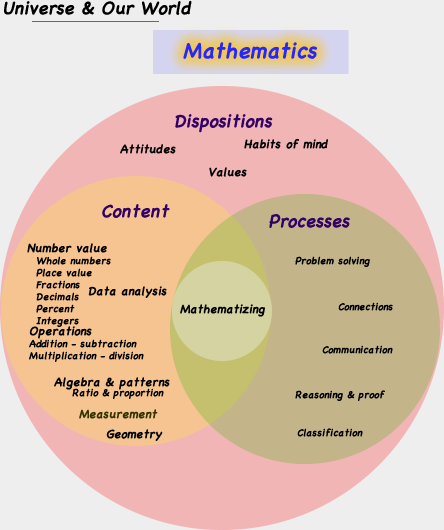
The content in these documents can be classified into big categories such as:
- Mathematical processes and mathematical content
- Knowledge, skills, and dispositions
- Mathematical processes, content knowledge, dispositions or attitudes or habits of mind, and perspective
- See more information on how these categories have been selected.
- And is represented visually in the following diagram:
Resources to create a mathematical knowledge base
The National Council Teachers of Mathematics (NCTM) organizes their standards with three big categories - mathematical processes and mathematical content (each with five sub categories) embedded in a disposition for mathematics.
- Mathematical processes - 1. problem solving, 2. connections, 3. proof and reasoning, 4. communication, and 5. representations;
- Mathematical content - 1. number value and operations, 2. geometry, 3. algebra, 4. measurement, and 5. data analysis and probability.
- These standards embed the idea of disposition and value of math through out their explanations and guides.
- Reference to reflect on the importance of these categories and your professional development. Article Beyond the Math Wars: Focus on teachers to improve instruction Kappan .pdf
Common Core State Standards - Organize their categories into two big areas: Standards for Mathematical Practice and Standards for Mathematical Content.
Project 2061 (AAAS) - Initial source - Science for All Americans. YES, I know the title is science, but it includes the nature of mathematics as well as other areas besides science.
Each of us has our own ideas of what mathematics is (mathematical literacy). Whether we have it in a mental map or outlined on paper or electronically.
Here is video of the fields of mathematics map & explanation video (11:05)
Therefore, if we haven't document our ideas, we should.
We don't have to create it from scratch.
We can review the documents above or others and use them as is, or cut and paste to create our map or outline of what we believe needs to be known and done to be mathematically literate. Our mathematical conceptual framework for mathematical literacy. To do so will allow us to teach more effectively and confidently.
My mathematical knowledge base is outlined with categories adapted from NCTM and AAAS: big ideas: dispositions, processes, & content. Written as concepts and outcomes necessary to be mathematically literate. We can be use it to reflect on our mathematical knowledge to plan and facilitate student's mathematical literacy and to edit it as we develop professionally through reflecting on our professional development focus questions as described in our professional development model.
While being mathematically literate is necessary to teach mathematics, the real reason we develop as teachers is to teach, which brings us to planning and teaching to facilitate math literacy.
Continue exploring professional development with these resources on mathematical content and pedagogy, (how people learn mathematics, how to plan units and activities, and how to teach mathematics).