Teaching & Learning Mathematics in Elementary & Middle School
Syllabus or outline for personal development
UPDATE IN PROGRESS
Welcome!
This comprehensive resource serves as a valuable guide for preservice teachers and current educators of mathematics education, encompassing the entire K-8 curriculum. While professional development paths may vary, this corpus synthesizes and organizes extensive research, wisdom of practice, and expert guidance to facilitate the acquisition of essential knowledge and skills within an 18-week timeframe.
The provided resources encompass both textual and video content, offering a practical and realistic approach to enhance your mathematical education expertise.
Enjoy!

 This plan or syllabus is to help prepare emergent and current mathematics professionals who are confident in their ability to learn and teach mathematics by creating an environment in which learners are welcomed and challenged to be confident while learning and using mathematics to attain mathematical literacy.
 |
Short list of assignments or table of contents Assignment details |
|
Your goals should be congruent with your Principled Procedures |
|
 Suggestions for a great learning experience or suggestions to orient yourself for learning! Suggestions for a great learning experience or suggestions to orient yourself for learning! |
 Printed professional math educator resources Printed professional math educator resources |
 Educational mathematics
organizations, journals, and related web sites Educational mathematics
organizations, journals, and related web sites |


 HoB home page
Summary list or table of contents for
Explorations goal setting
& summaries
Reading - Self Selected
- See reading suggestions and select books to supplement the HoB's pedagogy and math notes.
Book reading goals - include source
1.
2.
3.
4.
5.
Research investigation (60)
- See research
Topic & question -
Two sources (one could be from Construction)
1.
Findings -
2. Research from NCTM journals.
Source -
Findings -
Mathematics: Dimension explorations (600)
Math topics organized by NCTM dimensions.
Use the links on the schedule for exploration ideas, sequences, videos, and related activities or the quick links below to HoB's sources.
Note your ideas for the application of pedagogy and activities for the following dimension.
Content : dimensions
(120 per content dimension)
- Number value & Operations (addition, subtraction, multiplication, & division)
- Activities - problems, units, packets ...
Investigation choice -
Integration of process dimension -
- Activities - problems, units, packets ...
Investigation choice -
Integration of process dimension -
- Geometry & Visual spatial reasoning & representation
- Activities - problems, units, packets ...
Investigation choice -
Integration of process dimension -
- Data Analysis & Probability
- Activities - problems, units, packets ...
Investigation choice -
Integration of process dimension -
- Measurement
- Activities - problems, units, packets ...
Investigation choice -
Integration of process dimension -
Process dimensions: (20 of 120 in content)
Integrate each of these at least once in the content investigations.
Videos to apply pedagogical knowledge - Overview with a list and explanations for groups of videos in the follwing cagegories.
- Classification,
- Number sense, & Counting
- Place value & number value 10-100
- Addition & subtraction of whole numbers
- Addition & Subtraction Whole Number Algorithms
- Multiplication & division whole numbers
- Multiplication & division algorithms
- Representation of rational numbers & adding & subtracting them
- Multiplying & dividing rational numbers
- Geometry
- Measurement
- Analyzing Data & Using Probability Algebra
(20 points each; Total 240)
Final review; 40 points
Curriculum Pieces (250)
Problem solving (50) -
Representing (50) -
Proof and Reasoning (50) -
Number value (50) -
Self selected. (50) -
Position Paper (110)
Outline (10)
Final paper (100)
Instructional sequence plan (100)
Reflection of teaching instruction sequence plan (30)
Total = 1300
Exploration actvities & descriptions
Overview
This section has detailed descriptions of the explorations.
In addition to the
- List of explorations summary sheet with points to set goals and provide a summary for your accomplishments.
- A learning sequence schedule with links to exploration activities and supporting sources provided for your convenience in an 18 week experience or if you want a more relaxed experience double each week for a 36 week experience.
Overall suggestions
When you get ready to read - never be in a hurry. It takes time to think about the big ideas, what they mean, and how teachers use them so slow down achieve flow and enjoy the mathematical and the pedagogical thinking and learning in your professional development process.
Professional development process model
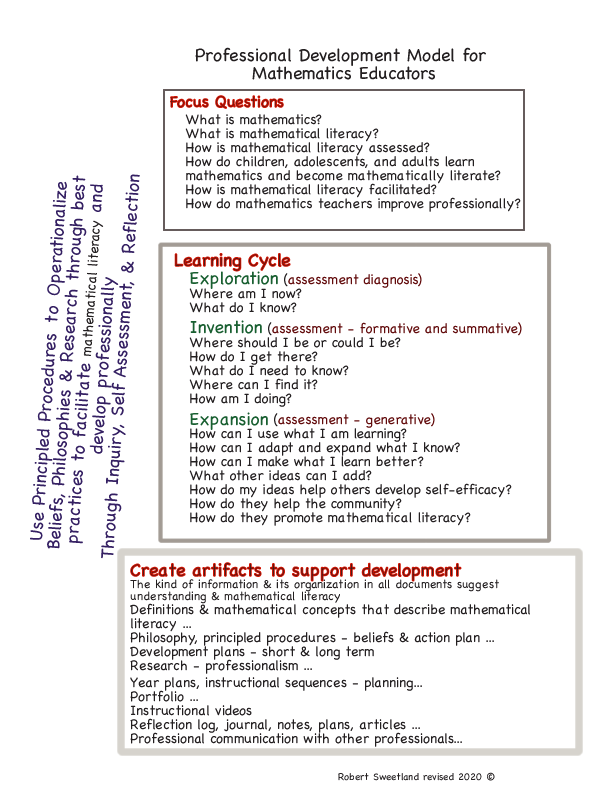
The purpose of your reading should be to reflect on what you know about teaching mathematics and how to improve on that understanding to become a better teacher. Therefore, as you read identify and record pedagogical ideas related to the mathematical ideas you believe will be useful for you as a professional educator.
In practice pedagogy interacts with the mathematics and we often don't take time to think about both, which can be problematic. So try to deliberately include both in your thinking by asking how students learn and teachers teach the ideas of mathematics.
If you have questions or comments about any of the information, write them do so that later you might ask a mentor or another professional educator. Or if taking a classs, the professor will usually provide time in each class by asking, "What questions do you have?"
Information for teaching and learning (pedagogy) and the processes or practices of mathematics (doing math or mathematizing) is usually included at the start of a book and should be mixed in with activities.
Some people tend to skip over this information, because they want to get to the activity section, or it may not match their previous experiences in math and hence their ideas of what is mathematical.
However, it often includes the essence of what is mathematical and will provide hints on how to become an outstanding teacher, who is able to facilitate student's learning and value of mathematics, by making better decision about: what to teach, what tasks to use, what questions to ask, how to sequence tasks, how to assess, what to assess, and how to make all the thousands of decision a teacher makes everyday.
Among them is the processes mathematicians use. This information is classified in the standards as processes for doing math. In the Constructing Mathematics series it is called mathematizing. In the Common Core State Standards for Mathematics (CCSSM) it is the eight mathematical practices. They are important to include in the pedagogy (teaching and learning) because are how learners do mathematics. It is what teachers need to know after assessing learners to know how to help them make sense of mathematical activities by providing tasks or problems and activities to help them learn mathematics.
Therefore, these processes include the what, how, when, and in what ways to facilitate learning.
The eight mathematical practices of the CCSSM:
- Make sense of problems and persevere in solving them.
- Reason abstractly and quantitatively.
- Construct viable arguments and critique the reasoning of others.
- Model with mathematics.
- Use appropriate tools strategically.
- Attend to precision.
- Look for and make use of structure.
- Look for and express regularity in repeated reasoning. Using the mathematical processes: problem solving, reasoning and proof, representation, communication, connections in a manner for lerners to acquire positive dispositions: values, attitudes, and habits of mind, for mathematics.
In the NCTM standards there are five process standards and five content standards for the content of mathematics.
Process standards to integrate with the content standardsß
- Problem solving
- Reasoning & proof
- Communication
- Connections
- Representations
Content standards
- Number value and operations,
- Geometry
- Measurement
- Algebra, and
- Data analysis and probability
These are good outlines of the information needed to learn to be math literate and the standard documents provide additional information to use for planning.
Exploration for Mathematics: Dimension explorations
(10 * 30 = 300)
- Review each dimension using the links in their week in the schedule. Also anyother resources in which you can identify big mathematical ideas (like the landmarks in the constructing mathematics series) identify them and how to communicate their meaning orally, in writing, visually, and concretely.
- Unpack the related information needed to construct their meaning. Identify these ideas and how they are related to each other and the big ideas.
- Create a sequence of how the ideas might be conceptualized by learners as they develop. What ideas have to be made sense of to build upon and connect with other ideas to understand and create the bigger ideas.
- Identify activities to assess and facilitate the conceptualization for the ideas.
- Create a concept map as listed in the schedule. Points will be assigned based on the evidence of an honest attempt to complete it.
- Concepts and sequences are referenced Online linked in the schedule and within your readings to use in completing this assignment. This information will be applied to diagnose and prescribe activities for students in the videos.
Video analysis exploration: (12*20=240)
- Consider the information in your readings that relate to the content topic of each group of videos. The big ideas for the topic and an unpacked sequence of information that needs to be known for that content area.
- Use the matrix provided for the sets of videos or create your own outline for the areas described.
- View the video clips. find links to worksheets in schedule.
- Review the description of what the learners did on the chart.
- Describe what you can infer about what the student knows and describe what specifically the student did to validate your inferences.
- Identify where in your sequence the learner's understanding is.
- Describe evidence to support that placement. (What they did or couldn't do and what that suggests they know.)
- Make recommendations of activities, from the book, your readings, or wisom of practice to be used to build on their understanding and move toward mathematical literacy?
Reading sources to explore
Review any mathematical resources you may be familiar with and select interesting ones. Then review the sources in my list.
I would sort these into five categories:
: If you have never read a comprehensive math methods text, you might want to select one.
- Elementary and Middle School Mathematics: Teaching Developmentally. 2022
- Mathematics a Good Beginning seventh edition. 2013
2. Cognitively guided construction related
- Math Teaching in Practice Series
- Children's Mathematics: Cognitively Guided Instruction. 2018
- Young Mathematicians at Work Series - Fosno series
3. Algebra related
4. Math activity books
Algebra exploration, reflection, & video applications (100)
Select an algebra book from the reading suggestions
Suggestions ...
- See topics in Algebra week.
Exploration - Reflection & application of construction (50)
Young Mathematicians at Work series or
Math Teaching in Practice
- Select one of the books from Young Mathematicians at Work Series - Fosno or Math Teaching in Practice Series
Exploration and reflection suggestions
- Read the book and identify at least ten ideas, from the book, you believe are important for teachers to know and apply.
- Describe how you have seen each applied with learners, yourself, or imagine how you would apply it or it should be used. And describe the value.
- elect one for application ...
- Evaluated on quality.
Research Exploration
Research ideas can be found in many places. Don't let the examples below limit your choices. The only requirements are to use information from different sources with at least one being NCTM research journal and try out your ideas in a class, group, or with an individual.
Enjoy!
Example of exploration inspired from the Young Mathematicians at Work. Fosnot/ Dolk books.
Research Exploration and Application Evaluation Criteria
_____ Step one - select a book with a cognitive theme for learning math, like the Algebra book or other Fosnot or newer NCTM books. Record the title and start Research Project file or folder.
_____ Step two - read and take notes. Identify the big ideas for each chapter and at least one question per chapter. The questions should be about an idea you might like to implement in a classroom,
How would I ... in my classroom.
Record them along with other big ideas per chapter you find relevant for each chapter. Thes are chapter notes which can be added to the Research Project file or folder from Step two.
_____ Step three When you complete the book, select one question. Write a short paragraph on how you could answer it, what kinds of answers you might expect, and how you might implement your discovery. Identify what benefits could be expected by learners who participated in if they were implemented. Save these notes, put them in the Research Project file or folder to use to complete this exploration. That completes step three.
_____ Step four Continue your research (using the NCTM sources below) This research is to find if other people's ideas and/or their research support what you discovered. It may be ideas you already know about or ideas you haven't discovered yet. Look for information that might be more successful and/ or support change and/ or suggest a certain practice be continued. Also find or create a rationale that would convince students, parents, teachers, and administrators that the practice you are recommending has advantages. Collect your information and put it into the Research Project file or folder (this may also include copies, notes, printouts, pictures, webs, clippings; with or without notes in the margins or highlighting).
_____ Step five Write a summary, that could be published
in a school newsletter or letter home to inform parents..., of your plan and how you would
intend to use it in the classroom with their children. Keep it brief, to
the point, and powerful. You should mention that those who would like additional
information should contact you. Then write a briefer explanation as to
what you would do if a parent... contacted you. This document into the Research Project folder and hand it in.
Your research must include the following
Possible references
- Fosnot book(s); One of three and Algebra one.
- Other text;
- Journal for Research in Mathematics Education; or NCTM yearbook section; and
- Teaching Children Mathematics
- Mathematics in the Middle Grades.
Research exploration possble evaluation criteria
- Completeness of Big ideas from book chapters and question about what you might like to implement in a classroom. A list of ideas by chapter big ideas per chapter as well as any other chapter notes you desire. (50)
- Selection of one question identified, how you plan to answer it and what kinds of answers you expect as well as how to implement your discovery. (50)
- Presentation of the plan to ...
- Personal investigation complete with letter desired supporting information in the file or folder.
- Quality might include:
- Use of more than four quality sources;
- Creative and critical thinking with the logical development of ideas based on research and wisdom of practice and sound reasoning;
- Ideas consistent with NCTM, other Standards, wisdom of practice, and principled procedures of mathematics;
- Inclusion of necessary materials; and
- Quality of writing is concise yet comprehensive presentation of ideas.
Exploring a Research question and suggested implementation from NCTM journal(30) and other book. Journal for Research in Mathematics Education) (30)
The purpose of research is to ultimately discover ideas to use to facilitate learning. Consider this activity as an opportunity to create a document to communicate to peers, administrators, parents, or other interested people what you intend the research to support.
Topic from readings - Cognitively guided construction group that encourages learners construction.
- Identify an idea or question from your exploration, reflection, implementation of ideas related to teaching and learning mathematics you would like to know more about to better facilitating mathematical literacy in your learners from your readings.
Write the topic, questions, or investigation that interests you.
After you select, then create a plan.
Note if you there is related information in the other Books you chose.
Do a reasearch search of NCTM journal for your tipic, question, or investigation and identify relative sources.
Identify the best journal source, read it, and describe how it supports your exploration. (30)
Find and describe suggestions to implement your idea or answer your question and explain what gives you confidence it will achieve positive results with students.
Evaluated on the quality.
You might want to use the PQRS arguement framework to write a short summary to convince peers, administrators, and parents.
Or for a more detailed position analysis.
** Journal for Research in Mathematics Education (JRME) is the premier research journal in mathematics education and is devoted to the interests of teachers and researchers at all levels--preschool through college. Published by the National Council of Teachers of Mathematics (NCTM).
Mathematics Teacher: Learning and Teaching PK-12 (MTLT) is published by the National Council of Teachers of Mathematics (NCTM).journal that reflects the current practices and knowledge base of mathematics education, aalong with the consideration of mathematical principled procedures. Content is peer reviewed and ranges from preschool to 12th grade.
Mathematics Teacher Educator is a scholarly, peer-reviewed journal for practitioners. Three issues of the journal are published each year. Its purpose is to build a professional knowledge base for mathematics teacher educators that stems from, develops, and strengthens practitioner knowledge.
Legacy journals
- Teaching Children Mathematics
- Mathematics Teaching in the Middle School
- Arithmetic Teacher
- Mathematics Teacher
Curriculum pieces (250) ...
Suggestions ...
A teacher needs to have a solid understanding of what: mathematics is, what mathematical literacy includes, and based on that what we want our students to know at various points of time.
Comprehensive mathematical curriculum documents include or are based on critical ideas related to mathematical literacy, learning, and facilitating mathematical literacy. A framework or outline of these and other important ideas can be made to guide curriculum decision making and its documentation.
While the curriculum pieces are subcategories for some of the processes and content areas of mathematics, the information used to make curricular decisions is common among all.
The selected subcategories required for the course are: Problem solving (50) Representing (50) Proof and Reasoning (50) Number value (50) and a Self selected area. (50)
Samples for curricular areas or dimensions are shown in a corresponding matrix. Each of the five subcategories has the same four areas to document. These areas are:
- Concepts or big ideas with supporting information of what the students need to know or learn.
- Outcomes - what the students will do to demonstrate their learning or what a person can observe to use to infer the extent students have conceptualized the big ideas and related facts and concepts.
- Activities and activity sequences to provide opportunities for students to learn or conceptualize the ideas and apply them in problem solving situations.
- Evaluation levels - the possible levels students might demonstrate an understanding for the information.
Additional resources to assist are:
Resources for process and content areas:
- Problem solving - chapter 2 resources, problem solving directory and sample matrices for processes linked above
- Representing - book chapters and representing directory
- Proof and reasoning chapters 1 and 2 and algebra book, - | reasoning and proof mini lecture | reasoning and proof directory | concept map for reasoning and proof |
- Number value - chapter 3 or place value chapter 4 (number value directory) or any of the other chapters for whole numbers rational, fractions, decimals ...
- Selected area for math content could be Patterns and algebra directory | or Geometry directory or | Measurement directory or | Data analysis and probability directory |
Assignment - Year Plan Outline
Minimal requirements
An outline for one grade, one academic year. Provide an overview that briefly yet comprehensively explains: what mathematics is, what mathematical literacy includes, how people learn mathematics, how mathematical learning can be facilitated, and assessed.
Describes the big ideas of the curriculum. Includes goals or learning outcomes for a comprehensive multidimensional view of mathematics.
Evaluation criteria
- Includes introductory information to orient the reader
- Outcomes are appropriate for students' ability and development levels.
- Outcomes are described as observations.
- Content includes all categories for the dimensions (as described by the National Council of Teachers of Mathematics Standards) of mathematics.
- Scope is broad and deep. Broad with big ideas described (generalizations), concepts, and facts, is comprehensive, and has depth (detail) for an appropriate amount of content in the dimensions required to demonstrate competence at the specific grade level.
- Ideas can be supported with research and/ or wisdom of practice.
Position paper and outline or map (10 + 100 = 110) ...
Suggested resources:
- Chapters 0 - 2
- NCTM standards
- Principled procedures of mathematics
- Common Core State Standards for mathematics summary
- Suggestions for professional educator development. Including ideas for some of the categories
Outline or map (10)
- Outline or map words and maybe phrases that you want associated with categories related to how educators facilitate mathematical literacy: multidimensional math description, how people learn, how people become mathematically literate, how to help teach/facilitate/instruct/ mathematics literacy, and how to assess mathematical literacies' dimensions.
Final paper (100)
- Quality and comprehensiveness of the position taken as a professional math educator that is consistent with current research and wisdom of practice as it relates to mathematics as multidimensional, how people learn in general, how people become mathematically literate, how to help teach/facilitate/instruct/ mathematical literacy, and how to assess mathematical literacies' dimensions.
Instructional sequence teaching plan (100)
There are several ways to think about information to sequence experiences for students:
- Look at a big idea by imagining a mapping of ideas from simplest to complex (big idea), how one idea logically fits or is required by another in a hierarchy of complexity. (Doing this doesn’t imply that each idea must be taught in isolation or in sequence though).
- Look at how big ideas developed historically.
- Think how your understanding about a big idea was constructed over the years or talk to other people and ask them how they constructed their understanding over the years. This is limited to our more recent ideas since we don’t usually remember much about our own early understandings or misunderstandings as we developed or conceptualization for conservation, early number value, and such.
- Use experiences from working with students; observing their different levels of understanding and how they become more comprehensive over time.
- Read professional books, journals, and other publications on children's development of mathematical big ideas.
When you have identified three or more dimensions or categories (problem solving, representation, number value, ...) Then identify a topic that can be used to integrate parts of each into an investigation, study, or learning sequence.
Resources:
- Considerations for Planning to Facilitate Students' Construction of Big Ideas, Generalizations, Concepts, and Facts
- Review maps for unpacking big ideas | planning concept map categories with explanation | planning concept map for area | planning concept map for classification | planning concept map for reasoning and proof |
- Sample plans: from best to worst
| Counting |Shows depth of planning integration of mathematical dimensions, developmentally appropriate ... - Rounding numbers and body proportion | Includes integration of mathematical dimensions, good for proportion, could use editing for clarity and more depth for procedures
- Card trick | Includes integration of mathematical dimensions, good for proof, could use some editing for clarity.
- Reading and writing numbers with numeral and words | Good activity for skill building and necessary skill, doesn't include integration of mathematical dimensions,
- Estimating chocolate chips in a bag of Ahoy chocolate chip cookies | Activity to integrate mathematical soutions with real life.
Reflection (70) ... Suggestions ...
- A good reflection includes discussion on how teachers make decision.
- How teachers interpret or make inferences as to what students know, how teachers make decisions based on this information, and how this process continues on the fly through learning sequences by collecting and analyzing assessment information to determine current levels of understanding for different students as they continually progress from one level to the next.
- For helpful questions to consider for comprehensive reflection, read hints for reflection.
Total points 1300
Suggested schedule of explorations
Week 1 Begin to set goals and review your educational philosophy
Select your initial readings from the suggested reading resource.
- Decide if you want to include a comprehensive text or use the online resources at the Hob.
- Select & obtain a copy, begin to read, reflect, & note information for explorations
- Constructing Mathematics books by Fosnot/Dolk
- Number sense grades k-2
- Multiplication and division 3-4
- Fractions, decimals, percent 5+
- Math Teaching in Practice Series
- Constructing Mathematics books by Fosnot/Dolk
- Obtain a copy of your choice from the algebra section.
Reflect on your current practices for teaching and particularly mathematics and read your selected readings for teaching and learning math.
Reviewing ideas about education and teaching in general
How long has it been since you reflected on your overall philsophy of education? If it's been awhile or you would like to compare, consider this agenda. Then write or update your general educational philosophy as needed.
Review information on why we have theories and reasons for education, you can skip the two motivational essays to change current educational systems. Then read the 7 questions related to an educational philosophy and read my answers. Among the key ideas to consider from a general educational philosophy is how to make what students are learning immediately valuable for them so they can apply it in their lives.
- Agenda to review and document Educational purposes, Educational Philosophy, Principled procedures, & Classroom code of conduct or rules
- How do people learn? Learning theories - constructivism, rote learning, behavior, Vygotsky (ZPD), -
- How does learning take place? - Piaget learning theory
- How does thinking change as people grow and mature? - Development of reasoning preoperational thinking, While the idea of unique stages in an inappropriate model, there ar landmarks that are helpful in understanding how reasoning develops from birth. Landmarks like object permanacy, reversibility, transformation, conservation, concrete operational thinking,and formal operational thinking and reasoning independent of conent, combinatorial reasoning, and proportional reasoning.
- Motivation and self-efficacy. What motivates? Behaviorism, reinforcement (extrinsic and intrinsic) ...?
- Might want to model ideas from a Professional educator conceptual framework for their knowledge base
Week 2 Begin to focus on mathematics in education
What is mathematics and math literacy and how do they fit within education?
As you focus of the six questions in the development process, consider what documents you would like to create to communcate your answers and what you are as a math educator.
Possible documents - philosophy, principled procedures, framework, map, knowledge base, selected standards.
Process for development along with its outcomes
- Information to Describe & Become Outstanding Professional Mathematics Educator
- Describes how to integrate math pedagogy into a general education.
- A process for teacher development and answering our foucs questions.
- What is mathematics?
- What do people need to know to use mathematics and be mathematically literate?
- How do we assess what people know about mathematics - math literacy?
- How do children, adolescents, and adults learn mathematics - become math literate?
- How do we facilitate people's understanding of mathematical literacy?
- How do we improve our understanding of mathematics and how do we help other educators improve their understandings?
- Describes what professional educators need to know and be able to do.
- Defines mathematics and its dimensions.
- Principled procedures for a math educator
What is math?
Documents ...
- Explore and select a definition of mathematics and outline dimensions with some subtopics
- Math definition and content map
- Math content map
- Categories in standards
- Categories in knowledge base
What do people need to know to be math literate?
Concepts and relationships to include in the map:
- Standards can inform teachers and curriculum designers about making curricular decisions? Example these two curricular documents:
- NCTM standards,
- Common Core State Standards for mathematics?
- HoB Knowledge base of math concepts and outcomes
- Project 2061
How do we facilitate math understanding & literacy?
How do we teach mathematics?
- Set a focus on math instruction.
- Take the math pedagogy survey,
- Review what research suggests about the survey
- How did you response compare to what research suggests? Continue to reflect on how this information will inform you practices.
- Remember, for me and many others, communication is at the center of a teaching model or framework, it is the pedagogical link between students, society's mediators, and educators.
- What is the difference between conceptual and procedural knowledge and learning. Andhow are each taught? - Card tricks
- Degree of representations as - hands-on, minds-on, formal operational.
- Principled procedures for a math educator
- Curriculum framework or outline.
- Questioning - Exploring questioning in pathways to understanding, includes open ended and closed questioning
- Technology (TDI, TEI, TMI. using the computer as a tool, tutor, and tutee
- Suggested planning map categories with explanations for each category.
Week 3 Processes of mathematics suport flexible thinking
How flexible are your mathematical abilities?
Here are some problems to challenge your math flexibility.
- Mental math quiz - Travel to the quiz, read a problem, solve it in your head, and write the answer on the paper beside the number of the problem. Remember to solve the problem in your head. ONLY write the answers.
- When you are done check out some solutions I have used and others I have been told.
- How did your solutions compare? How do these solutions compare to different ways of teaching math and what might be described as good practices to encourage learners to be flexible when solving problems?
Flexibility for solving math problems is enhanced with the processes of mathematics, which can help introduce alternative methods beyond algorithmic calculation. However, like cognitive and procedural, process and algorithmic are both valuable with knowledge of their uses.
Let's focus on process dimensions of math.
- Sample activity to show how the five process dimensions are integrated in a math problem ...
- How many squares activity
- Review the problem and teaching notes to see how it integrates all the process dimensions of the math standards and could also include social, group, and collaboration skills.
The use of the processes help with finding all the squares, understanding when we are successful, and communicating with others about the activity.
The schedule includes at least a week to explore each of the dimension five processes and five content. But first, we will explore planning.
Week 4 Probem solving & representation
Begin to work on your curriculum piece for Problem solving
- Check out the resources at this link for Problem solving. Problem solving is one of the categories in the processes dimension. I would bet it is in every curriculum or standard categorization of mathematics and mathematical literacy.
- What is a problem solving heuristic you would use?
- What problem solving strategies do you teach?
- What makes a good problem?
- Guiding Questions to Prepare Mathematical Investigations, Tasks, or Powerful Problem,
- Ways to communicate problems or represent problems, open ended and closed questions or problems.
- What does a person need to know about problem solving according to your selected readings?
- Would your ideal curriculum be like the one you are using or different?
- If different, record the differences on the - Big Ideas for my grade level.
- Identify skills or categories of information you think needs to be taught and learned to solve math problems?
- Create a map for the focus question - What information do you need to know to plan for teaching problem solving in mathematics?
- Curriculum piece problem solving due
Begin to work on your curriculum piece for Representation
- Select an activity, describe the activity very briefly and identify what was used as an external representations and what might have been students' internal representation.
Review the ideas and words in your position principled procedures, philosopy, and other documents to check for their consistency with you planning framework or outline.
Week 5 How will you plan for math lessons, lesson plan, activity sequence?
Describe how to facilitate mathematical learning for the overview of a year plan.
Are the problems on the mental math review good problems? Why or why not?
- If there are any links you have not visited in the curriculum plans or position paper, then visit them this week.
Week 6 Proof and reasoning
Review these resources to help develop
- Classification - properties or characteristics, similar, different; conditions - sufficient, necessary, equivalent, independent;
- My notes on valid arguments, reasoning, logic, & proof- inductive, deductive, counter example, faulty reasoning, needed information, extraneous information, generating cases, approximating, analogies; metacognition; & high order thinking...
- Here is a sample concept map for reasoning and proof
- Algebra book chapter 10
- Let's consider what a proof looks like at different levels of reasoning. - sample three different developmental levels odd + odd = even | video student proving |
- Begin to work on your curriculum piece for Proof and reasoning - see more information in the Curriculum Pieces Suggestions box above.
- Reasoning and proof curriculum piece due
Week 7 Patterns & algebra
Read and reflect on your chosen Algebra book
- Use your math curriculum to identify which of the following are included and give a brief example if it is. If they are not, explain how they should or shouldn't be included.
- Classification,
- Numbers - counting, whole, finite, rationale infinite, zero, integers;
- Sets - elements, union, intersection;
- Equality, inequality,
- Operations - +, *, /, inverse; symbols of inclusion;
- Patterns & functions
- Formulas and variables
- Additionally related information is at the Algebra directory and the Reasoning and proof directory.
- Select four ideas from an algebra book or other readings. Describe the value of each for learners, describe an activity that can be used with learners, one you have viewed, or participated in. Describe with a specific example of its use and tell how it was or wasn't of value and might be imporved. If you have not experienced one, then select, find, or make one up you would like to see or try and describe it, a specific example, and its value.
- Videos of algebra related instruction in elementary classrooms - accompanies Thinking Mathematically. 2003. but it isn't necessary to read to reflect on the scenarios in the videos. Other sources can provide information to relate to your reflection.
Week 8 Number sense
Create a concept map for learning number sense or number value.
- Suggestions resources from your readings of chosen books and ...
- Classification - Is the first step in quantifying objects. Therefore, identification of properties or characteristics, what makes objects similar, different; and what conditions are sufficient and necessary to make them equivalent or independent. See Science knowledge base and classification notes linked below.
- Classification concept map
- Classification development across ages by outcomes for scoring guides or rubrics
- Sorting disjoint sets and intersecting sets - must know how to create groups for counting
- Sorting same & different disscrimination tasks
- Class inclusion Subsets of sets
- Class inclusion 2 properties simultaneously
- Seriation order 10 strips
- Simultaneous relationships brothers & sisters
- Class inclusion animals
- Counting
- Prenumber sense
- Number sense
- Videos explorations|
- Read and reflect on
Week 9 Our Base Ten System of Numeration - place value - 100s, 10s, 1s,
Create a concept map for learning place value.
- Suggestions resources from your readings of chosen books and ...
- Place value,
- Video explorations
How is your position paper coming? Write what you want to include for what is math, math literacy, how to learn and teach mathematics.
- Position paper outline due
- Curriculum piece representing due
Week 10 Addition and Subtraction of Whole Numbers: Constructing Meaning
Create a concept map for learning addition and subtraction. Suggested resources Fosnot book and
- Suggestions resources from your readings of chosen books and ...
- Addition and Subtraction of Whole Numbers and basic operations
- (types of addition and subtraction), basic facts,
- Videos | video worksheet |
- Make a sequence for transition from addition and subtraction to using an algorithm. Suggested resources book and
- Video explorations
Mathematics research document completed - research question and suggested implementation from TCM or TMMS.
Week 11 Constructing Meaning for Multiplication and Division of Whole Numbers
Create a concept map for learning multiplication and division.
- Suggestions resources from your readings of chosen books and ...
- Multiplication and Division of Whole Number, basic facts, properties,
- (unpacking) | multiplication represented as rectangles
- second example
- third as - work sheet
- Videos | video worksheet |
- Create a concept map for transitioning to a multiplication and division algorithm. Suggested resources book and Multiplication and Division of Whole Numbers Algorithm
- Videos | multiplication & division video worksheet |
- Multiplication of multi-digit numbers | multiplication related to algebra |
- Curriculum Pieces for number value
Week 12 Break or catch -up week
Week 13 Some Theory about Numbers: Factors, Multiples, Primes, and Composites
- Suggestions resources from your readings of chosen books and ...
- Create a concept map for topics in the chapter.
- There are no videos for this chapter. Complete the worksheet
- Self-selected curriculum piece
Week 14 Rational Number - fractions
Not All Numbers Are Whole Numbers: Representing, Adding, and Subtracting
- Suggestions resources from your readings of chosen books and ...
- Create a concept map for rationale numbers. Suggested resources book and - Rational numbers - fractions,
- Video explorations
- Adding & subtraction video worksheet | mixed fractions |
Week 15 Multiplying and Dividing Rational Numbers
Create a concept map for learning the rest of the rationals.
- Suggestions resources from your readings of chosen books and ...
- book and - fractions decimals, percents - decimal concepts
- Videos to explore ratinal numbers & decimals
Week 16 Seeing is Believing: Visualizing & Geometry
Sequence plan due. Evaluation criteria
Geometry and visual spacial reasoning
- Suggestions resources from your readings of chosen books and ...
- Video explorations
- Create a concept map for learning geometry.
- concepts - developmental sequence - another way to view geometric development Van Hiele
Week 17 Measurement - Quantify properties of objects with their Measurements
What is the process of measurement?
- Suggestions resources from your readings of chosen books and ...
- Support - concepts - curriculum
- Video explorations
- Measurement video worksheet
Position paper due
Week 18 Analyzing Data and Using Probability
What makes data?
- Suggestions resources from your readings of chosen books and ...
- Create a concept map for data analysis and probability
- Data analysis & propability concepts & outcomes
- Video explorations
Done teaching Instructional Sequence plan
Reflect on mathematics instruction suggestions Evaluation criteria -
Put the finishing touches on assignments.
Graduation
Peer Evaluation of _________________________________ Book Presentation
Title:
| I believe suggestions presented to the class would be | Very beneficial for me to know | Somewhat beneficial for me to know | Not very beneficial for me to know | Worthless for me to know |
| Ideas were presented in a manner that makes me want to read the book. | Strongly agree | Some what agree | Somewhat disagree | Strongly disagree |
| Ideas were presented in a manner that helped me think about the topic in a new or different way. | Strongly agree | Some what agree | Somewhat disagree | Strongly disagree |
| If I don't find time to read this book, I would get it and use the ideas in my classroom if I have an opportunity. | Absolutely | Maybe | Probably not | Definitely not |
I would give the group ____________ points out of 25.
Lesson Sequenced Activities Plan Evaluation
Introduction or Overview
- Orients the reader to what is included in the plan: activities, goals, prerequisites, grade level, unique instructional methodology used, and other ideas to convince a teacher the plan is worth further reading. May include the following:
- Background information - includes supporting information to help the teacher. E.g. misconceptions, mathematical background information…
- Rationale - describes the importance of why students should learn the content of the plan. How it is important to everyday life develops a disposition to do mathematics, solve problems, and see the benefits of mathematics.
- Big ideas, Generalizations, concepts, facts and outcomes includes comprehensive and appropriate statements of what the students will learn. More powerful statements are easy to generalize to other situations or problems, are more comprehensive than facts, and connect to other mathematical ideas and real life.
Procedure for lesson plan has activities that
- are developmentally appropriate and should motivate students to use in everyday life and for further study of mathematics.
- are logically sequenced for all dimensions.
- include multidimensions.
- include opportunities for students to focus their attention on observable factual information, negotiate and bridge those ideas with reasoning to construct concepts and generalization for the big ideas.
- provide opportunities for students to communicate their learnings and extend the ideas to discover the limits and proceduralize them within the scope of the big ideas and into higher levels of learning for the required dimensions.
- include diagnostic, formative, summative, and generative assessment; within the instructional sequence and assesses all planned outcomes for all four ways.
- describes observable outcomes for all required dimensions.
- describes appropriate levels of outcomes (may include scoring guides or rubrics).
Overall
- Information is organized, word processed in electronic format readable by Microsoft WORD, and proofed for errors.
- References such as worksheets, charts, samples, are included and easy to find among the text or in an appendix.
- References sources.
Resources